Looking to buy a telescope? It’s crucial to decide what you want to observe before deciding whether a refractor or reflector telescope is superior. Refractor telescopes are used for seeing deep space objects like galaxies and nebulae because they employ specialized lenses.
On the other hand, since reflector telescopes use mirrors that offer greater sensitivity to all wavelengths, they are more popular with more extensive and brighter objects like the Moon and planets. The difference between refracting and reflecting telescopes is quite notable.
Let’s learn more about these 2 types of telescopes down below!
Due to their ease of construction and low price, Newton telescopes are the most popular reflectors on the market. The primary mirror, at the extremities, is where the star’s light is first refracted after entering the optical tube.

The reflector’s masterwork is its principal mirror. It must gather the light beams and direct them towards the eyepiece holder, the component on which we rest our eyes. Here, a method for causing the light beams to exit the tube is required.
As a result, a secondary mirror is placed just adjacent to the telescope’s front aperture, allowing rays to diverge and see an image.
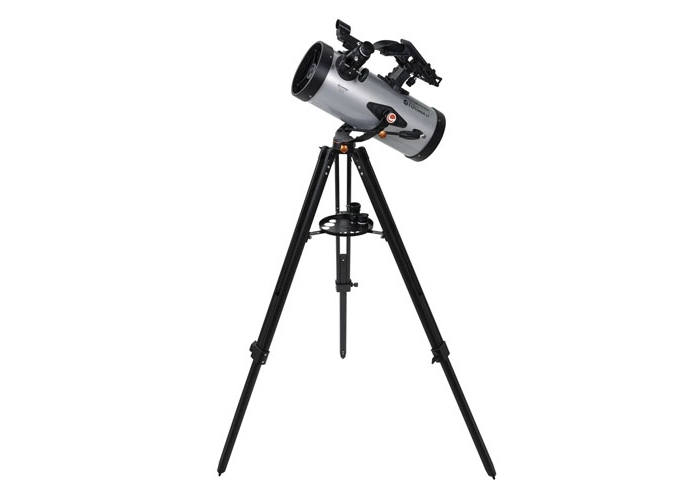
The primary mirror’s enormous size is an advantage. The larger the mirror is, the brighter the things appear in the eyepiece. However, a large mirror might quickly draw attention to the telescope’s optical flaws.
| PROS | CONS |
| 1. Better light-collecting capacity with a larger mirror. | 1. Optical quality is frequently subpar. |
| 2. Chromatic aberrations are absent (colored fringes around stars). | 2. Cleaning techniques for mirrors and collimation. |
| 3. Relatively affordable | 3. Open tubes are more susceptible to contaminants, humidity, etc. |
| 4. Hefty and large |
A monocular and a keplerian telescope operate on the same principles as a refractor telescope. The front lens is where the light enters to create the light beams arriving at the eyepiece holder, where we mount a camera or an eyepiece.

Refractor telescopes offer a more stable optical quality. They do not require any adjustments from the operator or viewer, but they do not capture as much light as reflector telescopes due to their compactness and lightweight.
| PROS | CONS |
| 1. Sharpness and contrast is impressive. | 1. Littler diameter = less light captured |
| 2. Lightweight and portable | 2. Chromatic irregularities |
| 3. Closed tubes provide dust and humidity protection. | 3. Higher cost |
| 4. Cleaning and maintenance are hardly ever done. |
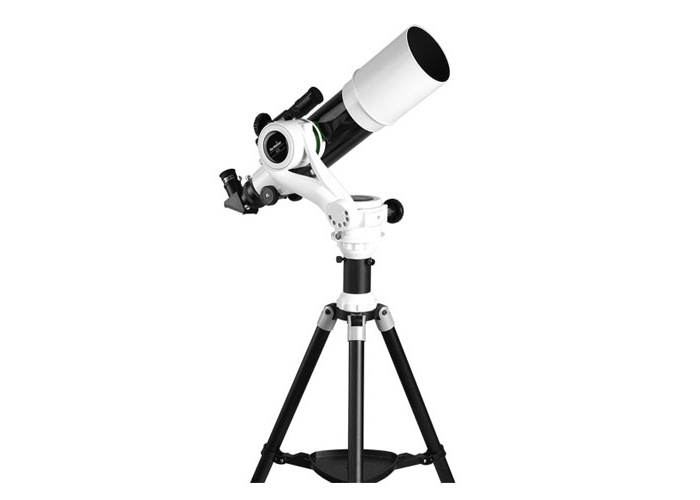
| REFLECTOR TELESCOPE | REFRACTOR TELESCOPE |
| 1. Utilizes mirrors | 1. Utilizes a lens |
| 2. Front eyepiece | 2. Rear eyepiece |
| 3. Gathers more light | 3. Lightweight and portable |
| 4. Require collimation | 4. Less collimation is required |
| 5. Dust and humidity can affect how well mirrors and tubes are cleaned. | 5. Requires little upkeep |
A refractor is a superior choice if you are interested in astrophotography because its specific optic design can catch celestial objects like galaxies and nebulae in deep space. A reflector telescope is the best choice if you’re new to astronomy or are interested in brighter celestial objects like the Moon or planets.

Reflectors are typically the best option for almost all visual things because they have greater apertures at comparable pricing. They can be excellent for deep sky astrophotography, but we don’t advise novices to use them because they demand a lot of upkeep and careful setup.
Reflectors can be excellent for visual purposes, but they can be very expensive for apertures of a similar size. However, they are great for astrophotography of the deep sky, and we suggest them to all newcomers to deep sky imaging.
So, should you opt for a reflector or a refractor telescope? That is the main indecision. There are strong feelings on whether it is nobler to watch the night sky unhindered by diffraction spikes or to dig deeper and admire spiky stars.
It comes down to using the most effective tool for the task at hand, along with, of course, your aesthetic preferences.
To view deep-sky fuzzies, such as far-off galaxies and galaxy clusters, one must instinctively go for a Newtonian reflector. Then again, a Newtonian reflector vs. refractor selection depends on personal choice.
The decision between a reflector and a refractor ultimately comes down to your intended purpose for the telescope, your financial situation, and whether you have the physical space to store or transport it. Every form of a telescope has advantages and downsides.